Vlad
Giurgiu.

Postdoctoral researcher in multiphase environmental flows at TU Wien.

scroll to read

Curious & hands-on.

I am a postdoctoral researcher at the Institute of Fluid Mechanics and Heat Transfer at TU Wien, working on experimental multiphase flows with an environmental focus. I am drawn to research that connects rigorous physics to how we live with the natural world. Collaborators usually find me curious and hands-on: equally interested in the data, the instruments that produced them, and the people behind both.

My current project addresses CO₂ sequestration — how convection-driven mixing and long-term storage mechanisms in geological formations shape the safety, predictability, and viability of carbon capture and storage. Earlier work developed optical measurement methods for the full rotational dynamics of anisotropic microplastic fibres in turbulence, an essential ingredient for predicting microplastic dispersion in the oceans. Between BSc and PhD, I spent four years in R&D at the Bühler Group, combining experimental measurements with CFD and heat-transfer simulations to reduce the energy and material footprint of food-processing equipment.

— Vlad
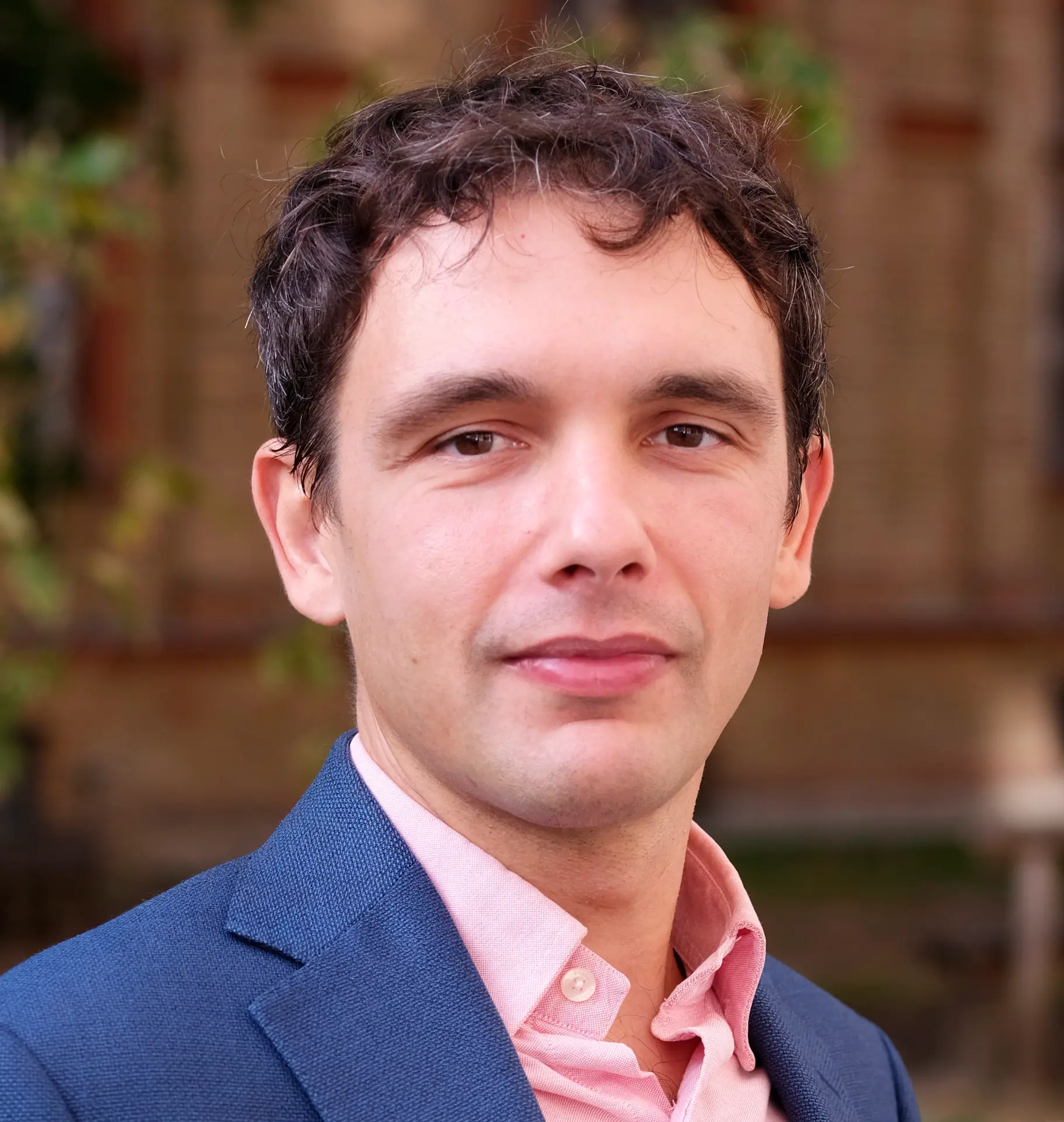
Portrait of Vlad Giurgiu.
at a glance
6peer-reviewed publications
60+citations — Google Scholar
3MSc theses supervised
education

Three degrees, one institution.

05/2021 — 05/2025PhD Mechanical Engineering — TU WienComplete rotation rates of curved microplastic fibers in wall turbulence.
06/2018 — 05/2021MSc Mechanical Engineering — TU WienThe TU Wien Turbulent Water Channel: measurements and statistics.
03/2013 — 05/2018BSc Mechanical Engineering — TU WienRayleigh–Taylor Convection in Confined Porous Media.

The same toolkit, three environmental problems.

05 projects
experiments · climate · industrial

My research investigates multiphase environmental flows: the turbulent transport of fibres, droplets, and dissolved species that drives several of the planet's most pressing problems. Three threads run through the work below — how anisotropic particles couple to turbulence (microplastics in the oceans), how convection sets the long-term fate of injected fluids (CO₂ in geological formations), and how to reduce emissions and energy consumption in industrial processes (Bühler food-line CFD).The common method is to build the instrument, take the measurement, and then close the loop with simulation, modelling, and learning.

TU Wien · ERC2025 — 2030 · current
project 01 · current

Reactive porous media.

Coupled fluid–solid dynamics of rock dissolution and mineralisation governing the long-term fate of CO₂ injected underground (De Paoli ERC team at TU Wien).

porous mediareactive transportCO₂ storageTU Wiencurrent
PRL · Exp. Fluids2018 — present
project 02

Fibres in turbulence — rotation & dissipation proxy.

Full 3D rotational dynamics of microplastic fibres and Kolmogorov-scale angular-velocity as a turbulent-dissipation proxy.

PTVPIVmicroplasticsturbulence
RSI · IJMF2020 — 2024
project 03

TU Wien Turbulent Water Channel + ML-PIV.

Facility design and 3D reconstruction of anisotropic-particle dynamics. ML-enhanced PIV for microfibre–wall interactions.

experimental facilityML-PIVPID control
PRF2017 — present
project 04

CO₂ sequestration — foundations.

Rayleigh–Taylor convection and universal scaling of the scalar dissipation rate in confined porous media.

porous mediaclimatemixing
Ansys UC2013 — 2017
project 05

Food-processing flows at Bühler.

CFD optimisation of waffle and baking-line components for emission and energy reduction.

industrial CFDefficiencyapplied R&D

Four papers, in reverse chronological order.

04 featured of 06
full record on Scholar / ORCID
Phys. Rev. Lett.2026

Demonstrates that the angular velocity of Kolmogorov-scale fibres tracks the local turbulent-dissipation rate, opening a new optical probe for one of the most elusive quantities in turbulence.

read
Phys. Rev. Lett.2024

First experimental measurement of the full three-dimensional rotational dynamics of microplastic fibres in turbulent flow — a critical ingredient for predicting how fibres disperse in the oceans.

read
Rev. Sci. Instrum.2023

Describes the TU Wien turbulent water channel — its flow-control loop, multi-camera 3D reconstruction system, and the methodology underpinning subsequent fibre-in-turbulence studies.

read
Phys. Rev. Fluids2019

Establishes a universal scaling law for the scalar dissipation rate during convective mixing in confined porous media, with direct implications for the long-term fate of injected CO₂.

read
The remaining two journal articles (Caridi 2025, ML-PIV 2024) live on Scholar and ORCID.

Lecturing, supervising, and three side initiatives.

2 streams
3 MSc theses · 3 side projects
teaching

Six years at TU Wien.

2022 — todaySupervision of 3 MSc theses — TU Wien3 theses
2017 — todayLecturer and tutor — Applied Fluid Mechanics Lab, Fluid Mechanics 1 and 2TU Wien
side projects

Three small autonomous initiatives.

interactive · for childrenin development
side project 01

Earth Seed — climate change for children.

Learn about climate change. Do something positive. Teach others.

earthseed-garden.lovable.app
lab × artongoing
side project 02

Artists in the lab — visual translation of fluid mechanics.

I invite visual artists into the TU Wien laboratory and walk them through the experiments.

dalmoniarognean.com/commissioned
page design · advisoryongoing
side project 03

Against Photography — page design + advisory.

Designing the website and advising on its direction for an artist-run exhibition space in Vienna's 15th district.

againstphotography.at

Five clusters, from optical metrology to languages.

05 / 05 sections
experimental + numerical + applied

Experimental Fluid Mechanics

i
  • Experimental design
  • Instrumentation engineering
  • Methodology development
  • PTV
  • PIV & ML-PIV
  • Image processing
  • Tomographic reconstruction
  • 3D high-speed camera setup
  • Synthetic-data uncertainty quantification
  • Vortical-structure detection
  • Pressure & velocity in gas pipelines
  • Optical density-distribution of baked wafers
  • Validation with numerical data
  • PID control

Numerical CFD

ii
  • Ansys Discovery Live
  • Ansys Mechanical
  • OpenFOAM
  • Heat-transfer in baking lines
  • Conjugate heat-transfer simulations
  • CFD geometry optimisation
  • Validation against experiments

Programming & Data

iii
  • Prompt engineering
  • MATLAB
  • LabView
  • Bash / Linux
  • Git
  • LaTeX
  • Statistical analysis
  • Technical documentation

Communication & Teaching

iv
  • Scientific writing
  • Lecturing & tutoring
  • MSc supervision
  • Conference presenter
  • Cross-functional R&D communication
  • Public outreach through art
  • Peer review

Languages

v
  • Romaniannative
  • EnglishC2
  • GermanC1
  • FinnishA1

Get in touch.

For collaborations, faculty searches, ERC / grant panels, or simply to ask about the water channel — I'm reachable by email and on the usual academic profiles.